


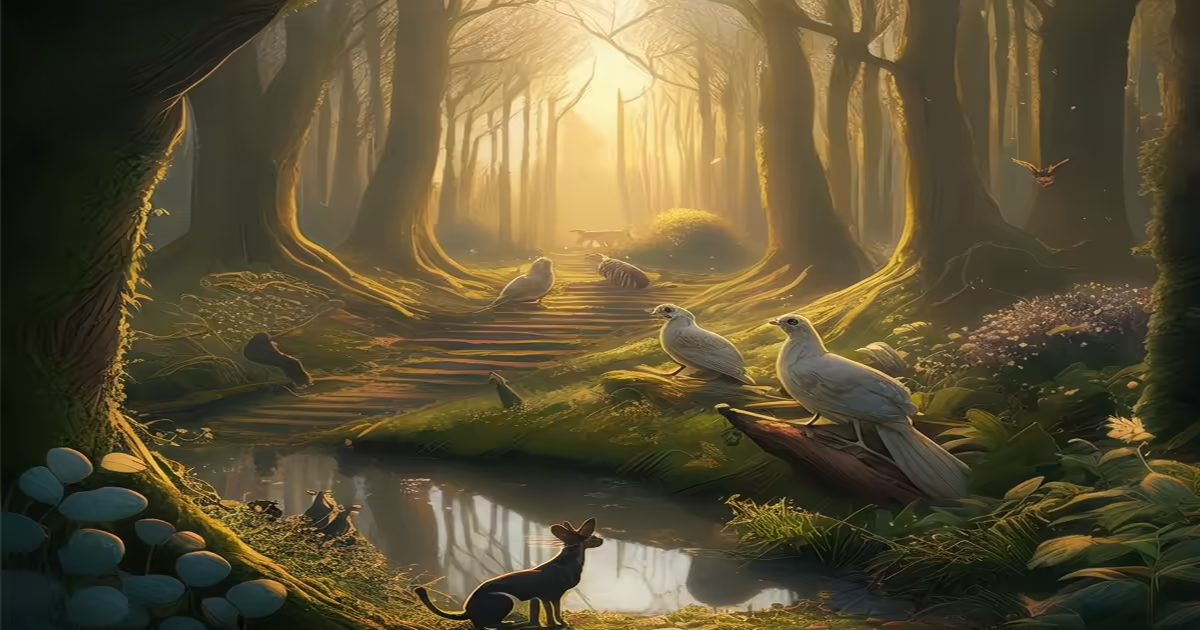
Once a hunting ground for royalty, an ancient woodland is now teeming with new life, thanks to the efforts of conservationists. In a secluded area of William the Conqueror's former hunting forest, a forgotten patch of wild England is transforming into a refuge for both threatened species and young people seeking respite from city life. A well-worn path winds through Horse Commons, a 93-acre expanse within the New Forest, inviting visitors into a landscape where nature is slowly reclaiming its hold.
Thousands of young people have explored the woodland trails, drawn to the Victorian Duck Decoy Pond, a tranquil spot that may now host England’s largest population of breeding toads. In early spring, the waters come alive. The RSPB's Izzy Williamson, who manages the site, describes the wonder of witnessing a "sea of eyes" gleaming in the darkness. At the pond's edge, young minds find stillness in the soothing rhythm of pond dipping, observing creatures and larvae.
The site encourages young people to participate in residential visits, which helps their engagement with nature and their mental health. They learn coping mechanisms and are encouraged to view nature as a safe space. Creatures once exiled from these lands are quietly returning, including Pine Martens, which were nearly wiped out in the past. They are now slowly bouncing back, and are found in pockets across the UK and Ireland. The sky above the woods is also alive with rare Bechstein’s Bats. Experts have identified 11 bat species using the reserve.
The site has no formal nature designation, which conservationists see as an advantage. It is a blank canvas, open to experimentation and habitat restoration. The RSPB purchased the land with the help of donations. The reserve is considered a crucial piece in the region’s ecological map. Despite its scenic beauty, Britain remains one of the most nature-depleted countries in the world.
New scrapes, or shallow ponds, will be created to support dragonflies and other species. The work has not been easy, as the reserve was overrun by invasive rhododendron. Volunteers have worked to reduce the area covered by the invasive plant. Horse Common is a living corridor of constant discovery. Locals and ramblers pass through, drawn to the flicker of wings and the rustle of undergrowth.
Grayling butterflies drift along, while speckled woods dance in the light. Damselflies mate in the air, and wood crickets add to the soundscape. The gatekeeper butterfly flits along, and wasp spiders gleam in their webs. These encounters are becoming rarer across the country due to habitat loss and other factors. Horse Common is offering breathing spaces for wildlife and giving the natural world a fighting chance.

5 Comments
Donatello
Sending my support to all the volunteers and conservationists involved! Your hard work is paying off!
Raphael
How much longer can we ignore the fact that humans are taking over? This doesn’t solve the real problems.
Michelangelo
Conservation should focus on urban areas too, not just some forgotten woodland.
Leonardo
It’s great to hear young people can engage in such a meaningful way with nature and learn about conservation.
Rotfront
This is just another attempt to romanticize a place instead of addressing real environmental issues.